

The Leadership Legacy of Luther: What a 16th-Century Christian Monk Taught Me About Leading Others

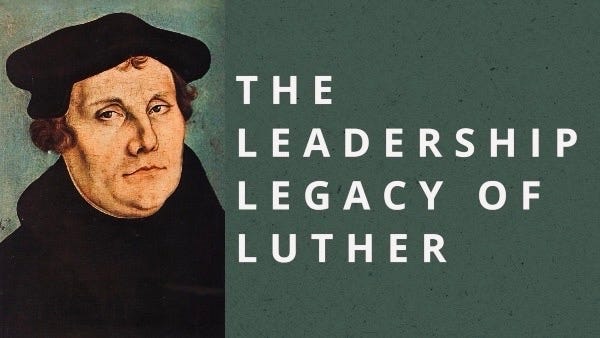
I’ve always been drawn to moments when a single act tips the balance of history—when conviction collides with a corrupt system and something irreversible happens. That’s what drew me to Martin Luther, the monk who, in 1517, walked through a quiet German town, took out a hammer, and nailed 95 statements to a church door—statements expressing his grievances for the internal corruption he saw in the Roman Catholic Church.
He questioned the Church’s action of selling forgiveness to believers like it was merchandise. The popular phrase of the day was: “As soon as the coin in the coffer rings, the soul from purgatory springs.”
Luther wanted open dialogue. He wanted debate but received only pushback. He wasn’t planning a rebellion against the Church—the very Church he loved and served. He simply wanted to address the beliefs and practices he felt contradicted the Word of God—to reform it according to Scripture. But instead of debating Luther, Church leaders ostracized him and declared him a heretic—a charge punishable by death—hoping it would silence him. Instead, it ignited a fire deep within him—one that, to this very day, has never been put out.
And yet, that small act by Luther—part theology, part courage, part conscience—to question the authority of the Church became the spark of the Protestant Reformation, reshaping faith, freedom, and even our idea of the self.
But I don’t think Luther’s story is just about history. I think it’s about you and me. Because every one of us, at some point, finds ourselves standing before something bigger than us—a system, a fear, a calling—wondering whether grace will hold if we speak up.
The Monk Who Couldn’t Find Peace
Luther didn’t begin as a hero; he began as a man haunted by guilt.
He was born in 1483, the son of a miner who wanted his boy to become a lawyer. But after a lightning storm nearly killed him, he made a desperate vow to become a monk. In the cloister, he prayed, fasted, confessed—sometimes for hours—trying to earn peace.
And here’s where I feel the ache of his story, because I know that feeling. That quiet, gnawing belief that if I just work harder, prove myself, perform better, maybe then I’ll be enough.
But for Luther, no ritual could silence his shame. Until, as a professor of theology, he encountered Romans 1:17: “The righteous shall live by faith.”
That verse broke him open. It was as if grace walked into the room and said, “You can stop now. You don’t have to climb; I’ve already come down.”
And in that moment, fear gave birth to faith. His private reformation became the seed of a public one.
What Made Him a Leader
When I think about what made Luther such an extraordinary leader, it wasn’t charisma or strategy. It was something deeper—a cluster of character traits forged in tension.
He was, in many ways, a paradox: fierce yet tender, brilliant yet blunt, stubborn yet deeply pastoral. And maybe that’s why his story still speaks to us—because it reminds us that leadership, at its best, flows out of transformation, not ambition.
Let me break down what I’ve learned from him.
1. Courage: Standing When It Costs You
At the Diet of Worms in 1521, Luther stood before the emperor, facing possible death. He could have recanted everything. Instead, he said, “Here I stand; I can do no other.”
That line gives me chills every time. Because courage, I’ve learned, isn’t the absence of fear; it’s the refusal to let fear have the final word.
Luther didn’t stand because he was fearless. He stood because his conscience, shaped by Scripture, left him no other choice.
Sometimes courage will ask you to stand—to say no when compromise would be easier, to speak when silence would be safer. And like Luther, you’ll feel the tremor in your voice. But that tremor is often the sound of truth taking root.
2. Conviction: The Inner Compass That Refuses to Drift
If courage is standing firm when the storm hits, conviction is knowing why you’re standing there in the first place.
Luther’s courage didn’t come from personality; it came from principle. When he said, “My conscience is captive to the Word of God,” he wasn’t grandstanding—he was surrendering. His conviction wasn’t defiance; it was dependence—a settled trust that obedience to God mattered more than approval from men.
Conviction, for Luther, was the moral compass that refused to drift. It was the alignment between belief and behavior, the inward yes to truth that made every outward no possible.
And I’ve come to believe that kind of conviction doesn’t begin in public. It begins in the private room of your mind—in silence, in prayer, in wrestling with God until your will bends toward His.
When you lead from conviction, you stop chasing applause and start seeking alignment. You trade performance for principles. You stop asking, “Will this make me look good?” and start asking, “Is this true?”
In a world addicted to compromise, Luther reminds us that leadership isn’t just about being right—it’s about being rooted. Conviction is the quiet strength that holds when everything else shakes.
3. Clarity: Making Truth Understandable
Luther didn’t just argue; he translated.
By putting the Bible into German, he made faith accessible to ordinary people. He wrote hymns, catechisms, and pamphlets in the language of the streets. He turned theology into story, and story into song.
It reminds me that leadership isn’t just about seeing truth—it’s about making truth visible.
If I can’t speak in a way that helps others see what I see, I’m not leading; I’m just performing. Luther taught me that clear words can be holy acts—that language, when used faithfully, can be an instrument of liberation.
4. Perseverance: Faithfulness Over Fame
The Reformation didn’t happen in a flash; it was decades of exhaustion, opposition, and illness. Luther kept going. He wrote over sixty volumes of work, preached thousands of sermons, and organized churches while fighting depression and disease.
What I love about that is how ordinary it feels. His greatness wasn’t in grand gestures but in the steady rhythm of faithful work.
He didn’t reform the church in a day. He did it by showing up—again and again—with a pen in one hand and a prayer in the other.
There’s something deeply pastoral in that for me. Because we live in an age of immediacy, where everything has to scale, trend, or go viral. But faithfulness—the kind that changes the world—often looks more like plodding obedience than explosive success.
5. Humility: Reformers Need Reforming Too
And yet, Luther wasn’t a flawless saint. His later writings—especially his antisemitic rhetoric—are painful to read. His temper could be cruel; his words, sometimes reckless.
It’s tempting to airbrush that away, but I think facing it is part of the point. Luther’s own theology reminds us that we are all “simultaneously saint and sinner.”
Grace doesn’t erase our flaws; it meets us in them.
If Luther’s shadow teaches me anything, it’s that conviction must always be held with humility—that every reformer needs reforming, and every leader must be led.
The Legacy That Still Shapes Us
Luther’s Reformation didn’t just fracture Christendom; it redefined what it means to be human. His belief in the priesthood of all believers planted the seeds of democracy and individual conscience.
He taught that every vocation—not just ministry—could be sacred. The farmer in his field, the mother at her cradle, the merchant in his shop—all were priests before God.
And maybe that’s the most revolutionary idea of all: that holiness isn’t reserved for heroes, but hidden in the ordinary acts of faith you and I do every day.
So What Does This Mean for You and Me?
When I read Luther now, I don’t just see a reformer—I see a mirror.
Because like him, I wrestle with fear. I want to be liked. I hesitate to stand when the cost feels high. But then I remember—grace never calls us to comfort; it calls us to courage.
Leadership, as Luther lived it, isn’t about control. It’s about standing where grace demands, even when your knees shake.
And maybe that’s the truest form of faith—not the absence of doubt, but the decision to act as if grace is still enough.
Here We Stand
Martin Luther once stood alone before kings and councils, armed with nothing but conscience and Scripture. But his courage wasn’t meant to be admired from afar—it was meant to be imitated.
You and I may never stand before an emperor, but every day we stand before choices that test what we believe.
The question isn’t whether we’ll feel afraid. The question is whether we’ll let grace steady our trembling hands long enough to say, “Here I stand, I can do no other, so help me God.”